
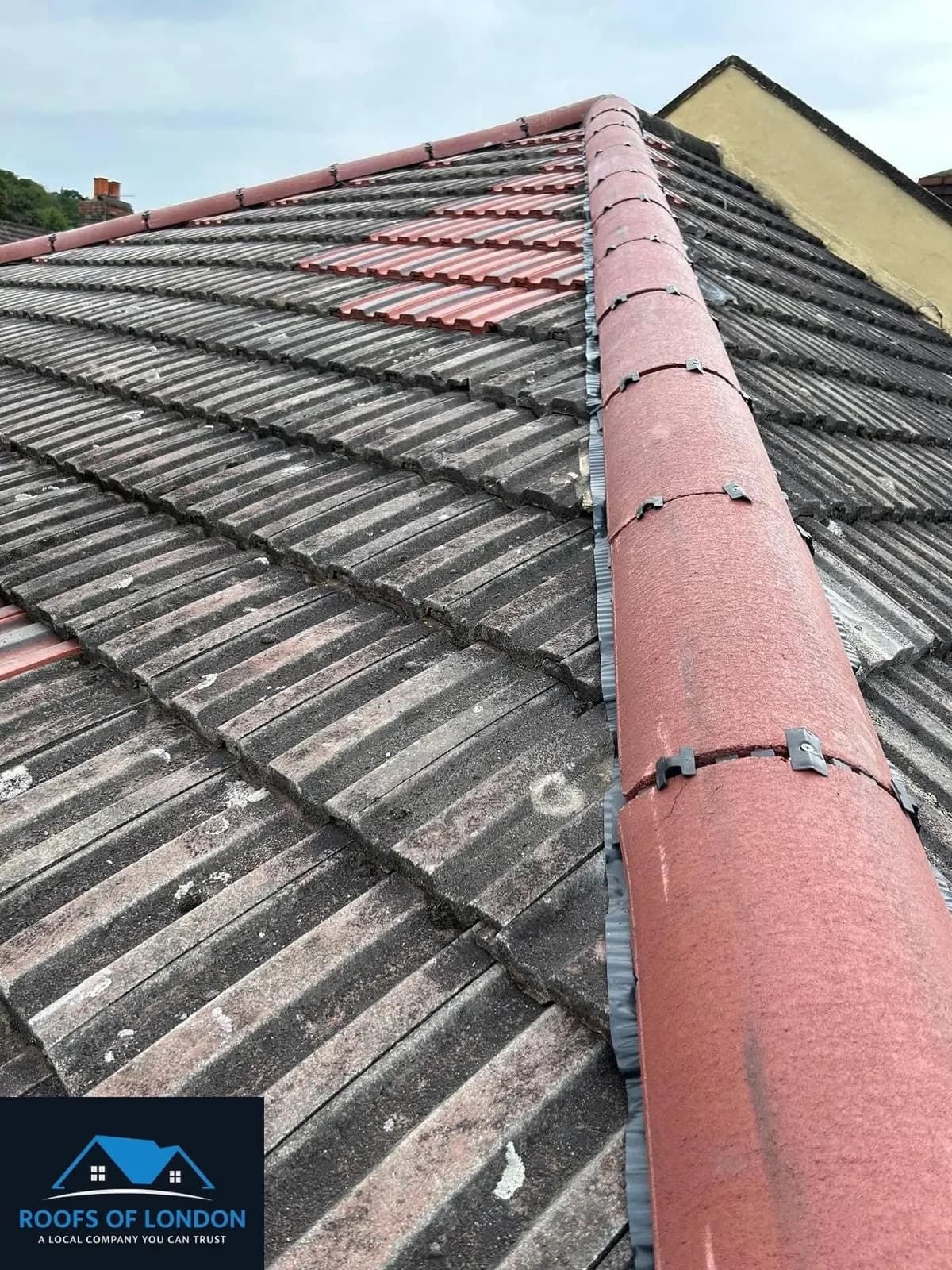
Ridge and hip repairs
Roof repairs in Ealing.
Ealing’s Edwardian and 1930s houses carry a lot of ridge and hip, nearly all of it originally bedded in mortar. When that mortar fails, water gets in at the very top of the roof and the stain can appear a long way from the cause. We find the real entry point and repair that.
- Re-bed or dryboth ridge repair options available
- Photosof the ridge and anything else we find
- Freeno-obligation roof repair quotes
Why ridges and hips let water in
Ridge and hip tiles on older roofs sit on a bed of sand and cement. Frost and slight movement shrink that bedding away from the tile, and the joints open up on the weather side first. Water entering this high can run down a rafter and show up a room or two away from the failure.
- Cracked or hollow mortar under the ridge tiles
- Open joints between neighbouring ridge tiles
- Lumps of mortar in the gutter or on the path
- Hip tiles working loose towards the eaves
Re-bed or dry fix: which suits your roof
If the tiles are sound and only the bedding has gone, lifting and re-bedding is often all you need, and it keeps the look of a period roof. Where the same ridge keeps failing, a mechanically fixed dry ridge is usually the better answer. In conservation areas such as Brentham Garden Suburb, a visible change is worth checking with the council first, so we raise it before you commit.
- Re-bedding suits sound tiles on a period roof
- Dry ridge suits repeat mortar failures
- Cracked ridge tiles replaced with the closest match
- A full re-roof only suggested when repairs stop making sense
Roof types across Ealing
Streets around Ealing Broadway and Hanwell lean towards Victorian and Edwardian housing, while Greenford and Perivale have many 1930s semis. Each has its own weak points, so we check the rest of the roof while we are up there and tell you what can wait.
- Clay plain tiles on Edwardian gables and bays
- Natural slate on Victorian terraces
- Concrete tiles on re-roofed 1930s semis
- Lead at chimneys and valleys checked at the same visit
How the job works
- 1Start in the loft where we canStains on the timbers and felt often point to the true entry point, which is not always under the mark on your ceiling.
- 2Check every ridge and hip jointWe go along the ridge and down each hip looking for hollow bedding, open joints and loose tiles.
- 3Send photos and a written priceYou see what we saw, with the re-bed or dry ridge options priced clearly so you can choose.
- 4Lift, clean and re-fixFailed bedding comes off, sound tiles are cleaned and reused, and the ridge goes back straight and secure.
Why choose us in Ealing
- Clear written prices for Ealing repairs before any work begins.
- Photos of the ridge, hips and any other faults, so nothing relies on taking our word for it.
- Straight advice on whether to repair or replace, even when the smaller job is the right one.
Common questions
Why is my ceiling damp when the ridge looks fine from the street?
Ridge mortar usually fails on the upper side and between the joints, which you can’t see from the ground. Water can also travel along a rafter before it drips, so the stain and the fault are often some distance apart.
Can a dry ridge go on a period house in Ealing?
Often, yes, but it changes the look of the ridge slightly. On a listed building or in a conservation area it is sensible to check with Ealing Council first, and re-bedding in mortar may be the better fit.
How can I tell if ridge mortar has actually failed?
Look for mortar pieces in the gutter, visible cracks along the ridge line or ridge tiles that look uneven. We can confirm it up close and send you photos.
Ready for a free, no-obligation quote?
Speak to our team today. London, Essex, Kent, Sussex and the Cotswolds.