
Local roofers · Ealing
Roofers in Ealing.
Ealing’s roofs change from one neighbourhood to the next: natural slate on the Victorian and Edwardian streets, clay tiles in Brentham, and concrete tiles on the interwar semis towards Greenford and Perivale. We work out what your roof is made of and why it is failing before we price anything, so the repair suits the house.
- Freeno-obligation quotes
- Photosof every job
- Mon–Sat8am to 6pm
Slate on Ealing’s Victorian and Edwardian houses
The bay-fronted houses around central Ealing, West Ealing and Hanwell were largely built with natural slate. Good slate often outlasts the nails holding it, a failure known as nail sickness, so slates begin to slip one at a time. A handful of slipped slates is a repair, but once they are moving across a whole slope, stripping and re-laying is the better use of your money.
- Slipped and cracked slates refixed or replaced
- Lead flashing renewed at chimneys and party walls
- Valley repairs on rear additions
- Sound slates set aside for reuse on a re-roof where possible
Brentham and Ealing’s conservation areas
Brentham Garden Suburb, built in the early 1900s, is one of London’s best-known Arts and Crafts estates, and it is one of several conservation areas across the borough. Its steep clay-tiled roofs, tile hanging and tall chimneys are a large part of its character. Here a modern substitute is rarely the right answer, so we match the original materials and advise you to check with the council before anything visible changes.
- Matching tiles sourced for period roofs
- Chimney repointing with the character of the stack kept
- Repairs kept to a like-for-like finish
- Clear photos to support any council query
Interwar semis in Greenford, Perivale and Northolt
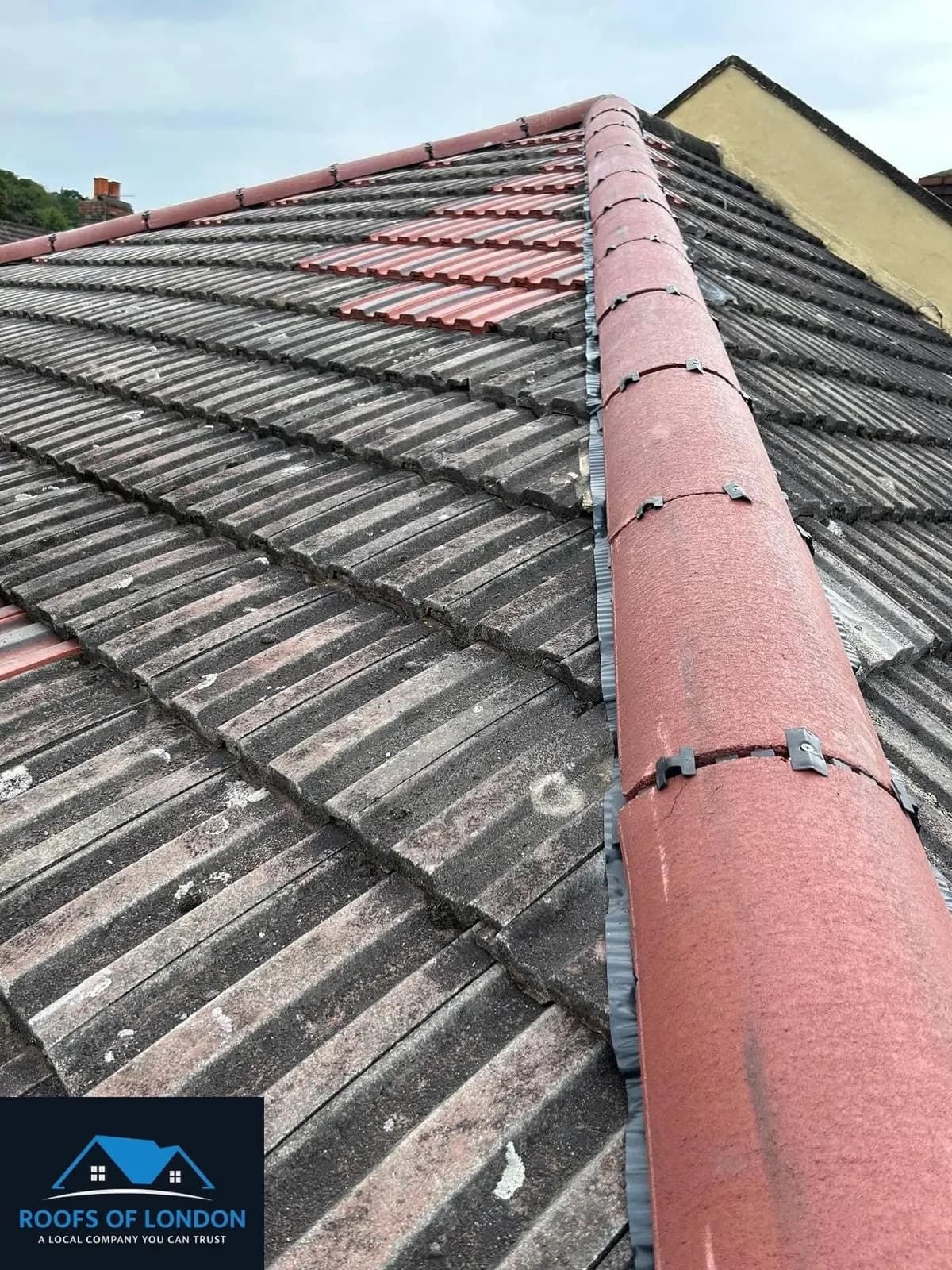
Many of the hipped roofs out towards the A40 were built in the 1930s, and plenty have since been re-covered in heavy concrete tiles. The weak points tend to be mortar on the ridges and hips, and the old felt underneath. If the tiles are sound, a dry ridge or a felt and batten repair can be far better value than a whole new roof.
- Mortar-bedded ridges and hips replaced with dry fixings
- Torn underfelt and rotten battens renewed
- Bay window flat roofs repaired or re-covered
- Full strip and re-roof when the tiles themselves have failed
How the job works
- 1Identify the roofWe confirm the covering, its age and any earlier repairs, because slate, clay and concrete all fail differently.
- 2Follow the waterWe check the loft and the outside of the roof to find where the water actually gets in, which is often some way from the ceiling stain.
- 3Give you the optionsYou get a clear written price and an honest view on repairing or replacing, with photos of what we found.
- 4Finish and recordWe complete the agreed work and photograph it, so you can see the parts of the roof you can’t see from the street.
Why choose us in Ealing
- Free quotes for Ealing homes, with no obligation to go ahead
- A clear written price before any work starts
- Photos of every job, so you can see what was done up on the roof
Common questions
Can old Welsh slates be reused when a roof is stripped?
Often some can. Slates that are sound and not delaminating can go back on, usually on the front slope, with new slates of a similar size making up the numbers. We sort them as they come off and show you what is reusable.
I live in Brentham. Can I change my roof tiles?
Conservation area rules can limit changes to the look of a roof, so speak to Ealing Council before changing any materials. Like-for-like repairs are what we would recommend there, and we match the original tiles as closely as we can.
How can I tell if my 1930s semi still has its original roof?
Thick, chunky concrete tiles usually point to a later re-roof, while smaller plain clay tiles are more likely to be early. The loft is also a clue: bitumen felt suggests a later job, and bare boards or no felt at all suggests an older roof. We can confirm this when we come to quote.
Ready for a free, no-obligation quote?
Speak to our team today. London, Essex, Kent, Sussex and the Cotswolds.