
Local roofers · Maidstone
Roofers in Maidstone.
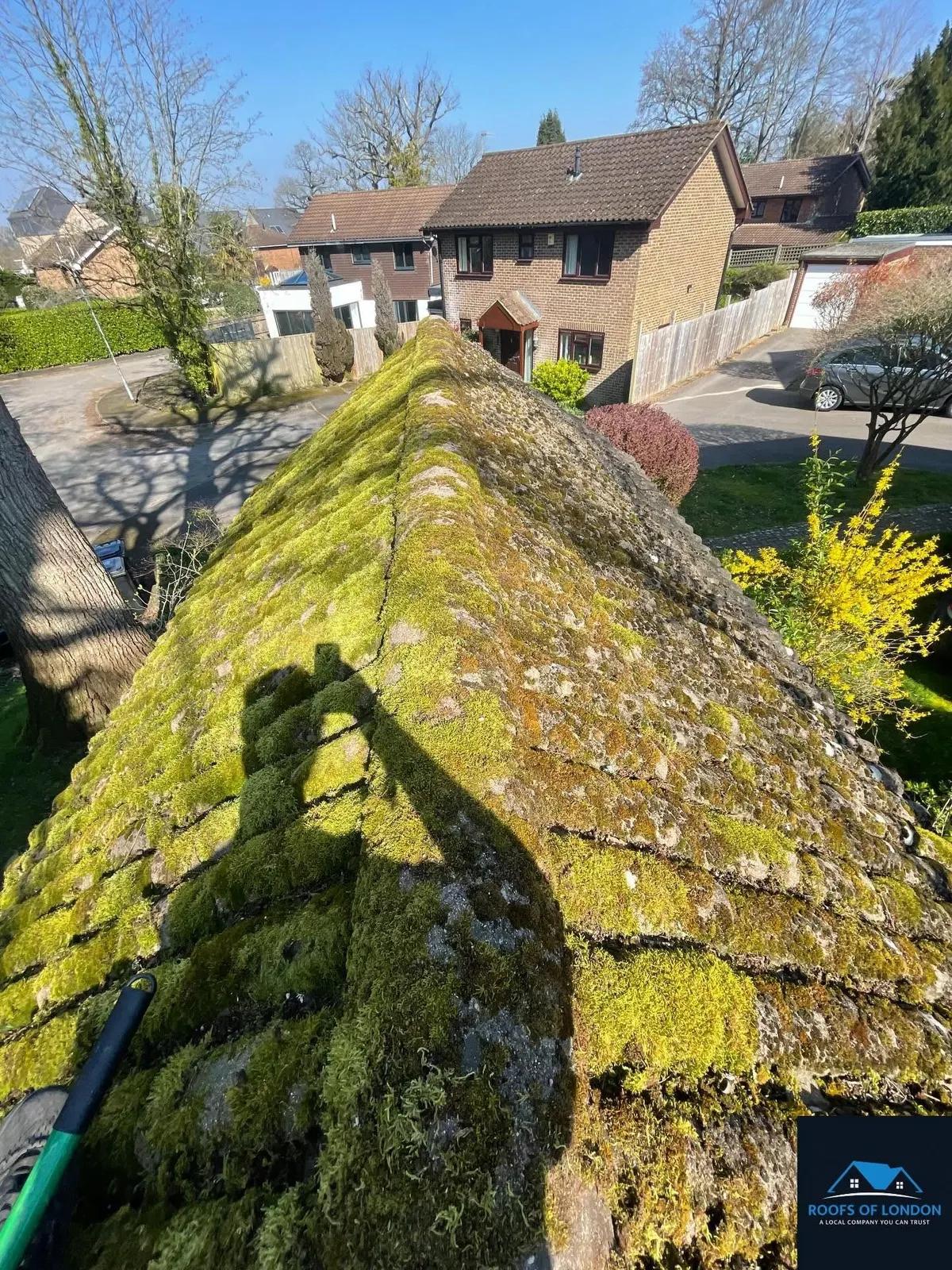
Maidstone sits in the Medway valley, and between the river, mature gardens and the shade of neighbouring houses, plenty of roofs here stay damp for much of the year. That’s why moss is often the first thing owners notice, though the real question is what is happening underneath it. We look past the surface and tell you whether the roof needs work at all.
- Honestadvice, even if nothing needs doing
- Photosof what we find on your roof
- Mon–Sat8am to 6pm
Damp roofs, moss and what it signals
Moss grows where a roof stays wet, usually on slopes that face north or sit under trees. A little moss isn’t an emergency, but thick growth holds water against the tiles and can raise their edges. It also breaks away and collects in gutters, so the first sign of trouble is often an overflow rather than a leak.
- Thick moss keeps tiles wet, and wet tiles suffer more in frost
- Clumps can lift tile edges and let wind-driven rain in
- Debris washing down blocks gutters and downpipes
- Tiles that have turned soft or flaky need replacing, not just clearing
Kent clay tiles and older buildings
Kent has a long tradition of clay roof tiles, and they appear on older houses in and around the town, as well as villages such as Loose and Bearsted. Handmade tiles vary in colour and shape, so new ones can stand out and matching matters. Local Kentish ragstone is also a feature of older buildings, and it needs care where a roof meets the wall.
- Slipped clay tiles are often caused by failed nails or perished pegs and nibs
- Sound old tiles can sometimes be saved and re-laid
- Lead valleys and abutments deserve a close look on older roofs
- Tiles are matched as closely as possible on period properties
Across the town, from Allington to Shepway
Beyond the centre, Maidstone’s housing is largely 20th-century semis and estates, from Allington and Barming to Shepway and Park Wood. Here the common roof is concrete tile over bitumen felt, and the common faults are ridge mortar, torn felt and tired timber fascias. Valley-side and hillside homes can also catch more wind than you’d expect.
- Mortar-bedded ridges that have cracked or come loose
- Felt that has torn or sagged at the eaves
- Rotting fascias that can be replaced in uPVC
- Flat-roofed garages and extensions with split or blistered felt
How the job works
- 1Look under the mossWe check the tiles, ridges and gutters to see whether growth has done any damage or is simply sitting on a sound roof.
- 2Show you the conditionPhotos make it clear what is cosmetic and what actually matters, so you are not relying on our word alone.
- 3Recommend only what’s neededIf work is needed we set it out in a clear written price. If it isn’t, we’ll tell you that too.
- 4Repair and clear the run-offWe replace what has failed and make sure gutters are flowing, so water can leave the roof properly.
Why choose us in Maidstone
- We tell you when a roof is fine as well as when it isn’t
- Free, no-obligation quotes across Maidstone
- Written prices and photos of every job
Common questions
Is moss on my roof actually a problem?
A light covering usually isn’t urgent. It becomes a concern when it is thick enough to hold water, lift tiles or block the gutters. If you can see clumps on the ground or in your gutters, it is worth having the roof looked at.
Should moss be pressure washed off a roof?
We’d be cautious. High-pressure water can damage older tiles, strip their surface and force water up under the laps. Check the condition of the tiles first, because if they are already soft or cracked, repairs need to come first.
Can old clay tiles be reused during a repair?
If they are sound, often yes. Tiles can be lifted carefully, the felt and battens renewed, and the roof covering relaid. Any that are cracked or flaking are replaced with the closest match we can find.
Why does the north side of my roof look so much worse?
It gets less sun, so it dries more slowly and moss and algae take hold. That doesn’t always mean it is failing, but slower drying does make frost damage more likely, so it is usually the slope to check first.
Ready for a free, no-obligation quote?
Speak to our team today. London, Essex, Kent, Sussex and the Cotswolds.