
Local roofers · Kingston
Roofers in Kingston.
Around Kingston upon Thames, the roof you have depends a lot on where you live: tall Victorian stacks in Surbiton, interwar semis through Berrylands and New Malden, and larger, more complicated roofs up on Kingston Hill and in Coombe. We look at the whole roof, chimney included, and tell you plainly what needs doing now and what can wait.
- Writtenclear prices before work starts
- Usuallyreply to enquiries the same day
- Honestrepair or replace advice
Chimneys on Surbiton’s Victorian villas
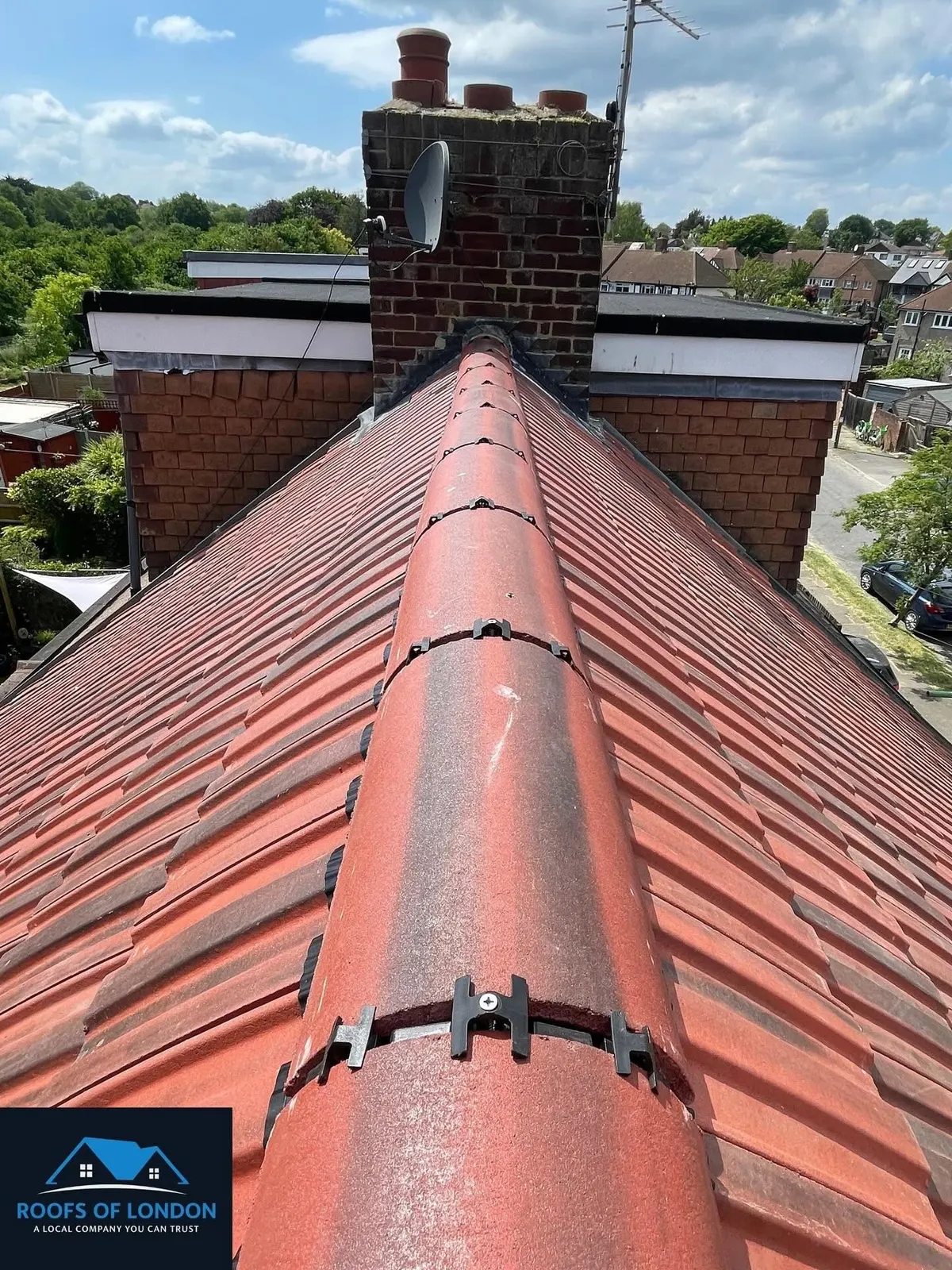
Surbiton grew up around its railway station in the Victorian era, and its older houses carry tall stacks that catch the weather on every side. Mortar joints wear back, flaunching on top of the stack cracks, and the lead where the stack meets the roof lifts or splits. Damp on a chimney breast is often traced back to one of these, not to the tiles.
- Repointing of worn mortar joints
- New lead flashing and soakers
- Replacement pots, cowls and caps
- Rebuilds where a stack has started to lean
Interwar semis in Berrylands, New Malden and Tolworth
These streets are full of 1930s semis with hipped roofs, bay windows and shared chimney stacks. Roofs of this age are often on their second covering, and by now the felt, battens and timber fascias can be worn even when the tiles still look fine. It is worth having all of it looked at together, as one scaffold can cover the lot.
- Flat and tiled bay window roofs repaired
- Fascias, soffits and gutters replaced in uPVC
- Dry hip and ridge in place of cracked mortar
- Full re-roof with breathable membrane where needed
Larger roofs on Kingston Hill and in Coombe
Bigger detached houses tend to have more hips, valleys, dormers and junctions, and each one is a place water can get in. Being up on higher ground also means more wind. On a roof like this, a leak is usually local, so a targeted repair often makes more sense than replacing a large area that is otherwise sound.
- Lead valley repairs and renewals
- Leak tracing at dormers and abutments
- Slipped tiles and storm damage made good
- Section-by-section advice on what needs doing first
How the job works
- 1Start at the stackWe check the chimney, flashing and pots first, as they are the most exposed part of the roof and a common source of damp.
- 2Work down the roofRidges, slopes, valleys and the roofline are all looked at, so nothing is priced in isolation.
- 3Separate urgent from optionalYour written price sets out what needs doing now and what can sensibly wait, so you can decide.
- 4Complete the agreed workWe carry out the job as priced and send you photos showing the finished work.
Why choose us in Kingston
- Clear written prices for homes across Kingston and Surbiton
- Straight advice on whether a chimney needs repairing, rebuilding or removing
- Photographs of every job, including the parts hidden from the ground
Common questions
Should I keep or remove a chimney I no longer use?
If the stack is sound, keeping it and capping it can be the simpler option. Removal can make sense when a redundant stack needs a costly rebuild. On a semi or terrace the stack may be shared with a neighbour, so that needs checking first, along with any chimney breast removed below.
What is flaunching on a chimney?
It is the sloped mortar around the base of the pots that throws water off the top of the stack. When it cracks, water can get down into the brickwork, so it is worth checking whenever a chimney is being repaired.
Can you fix a bay window roof without touching the main roof?
Yes. A bay roof is often a separate small flat or tiled roof with its own junction against the wall, so it can usually be repaired or re-covered as a job on its own.
Is it worth doing the fascias at the same time as a re-roof?
Usually, yes. If the scaffold is already up for the roof, the fascias, soffits and gutters are easy to reach, and the bottom edge of the new roof sits on a sound new roofline.
Ready for a free, no-obligation quote?
Speak to our team today. London, Essex, Kent, Sussex and the Cotswolds.