Local roofers · Gravesend
Roofers in Gravesend.
On the south bank of the Thames, Gravesend gets its share of wind and driving rain coming along the river, and the edges of a roof feel that first. Gable ends, bargeboards, fascias and gutters are often where a roof shows its age, long before the tiles do. We repair and replace them across the town, along with everything else on the roof.
- uPVCroofline that won’t need painting
- Writtenprices, agreed up front
- Same daywe usually reply to enquiries
Why gable ends go first
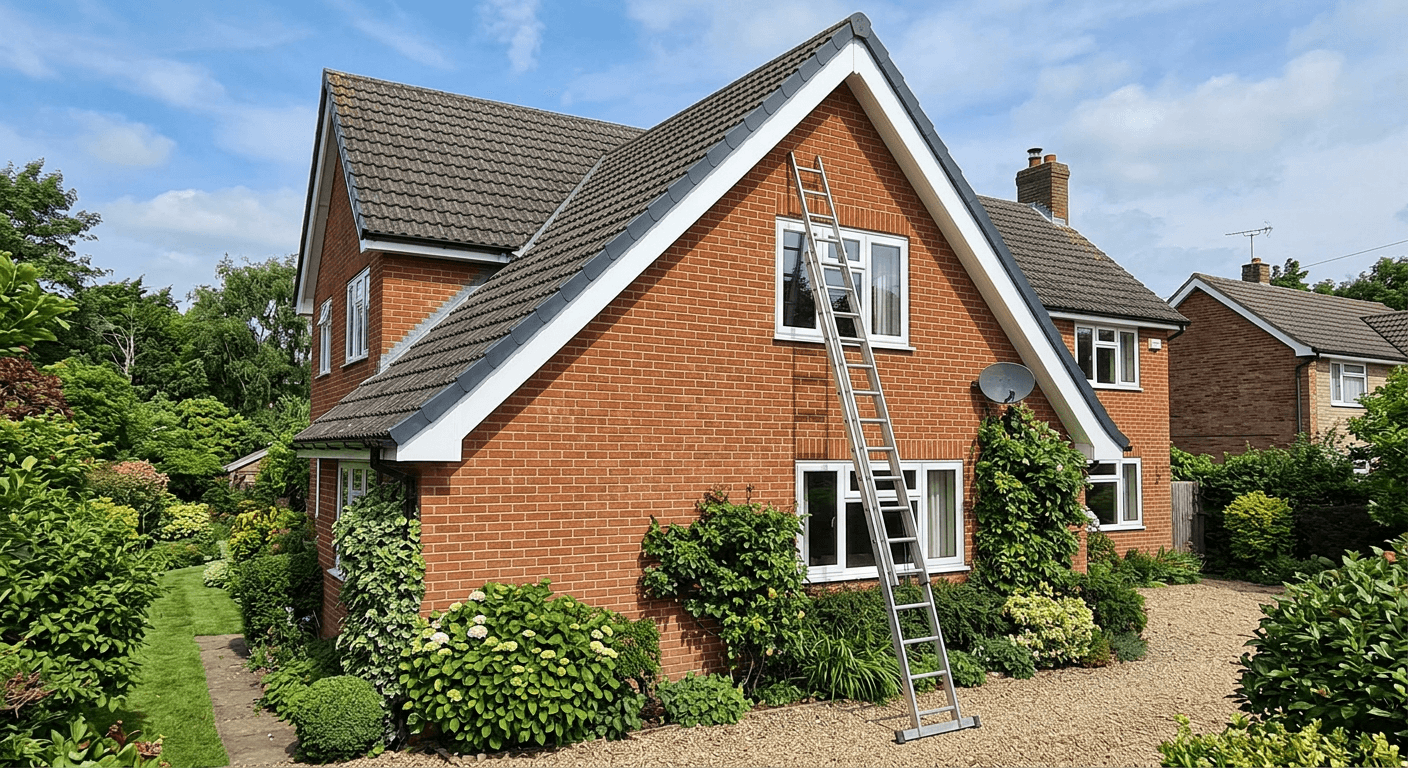
A bargeboard covers the exposed edge of the roof at the gable, with weather hitting it from the front and any failed verge letting water in from above. Timber lasts well while it is painted, but once paint fails, water gets into the joints and rot follows. Because this sits high up, it often goes unnoticed until a section comes loose.
- Peeling paint or soft patches are the first sign of rot
- Cracked verge mortar lets rain run behind the board
- Gaps at the gable give birds and insects a way in
- Water staining on the gable wall can point to a failed edge
Terraces near the river, semis on the hill
The streets around the town centre and towards Northfleet have plenty of Victorian and Edwardian terraces, with bay roofs, chimneys and rear additions. Moving south and uphill, you’ll find more inter-war semis with hipped or gabled roofs and post-war estates. Higher ground such as Windmill Hill is more exposed, so ridges and verges there have more to deal with.
- Terraces: bay roofs, valleys and lead flashings need regular attention
- Gabled semis: long bargeboards and verges to maintain
- Exposed homes: loose ridge tiles and mortar in the gutter
- Post-war homes: original timber fascias reaching the end of their life
Cap it or replace it?
If the timber is still solid, capping it with uPVC can be a tidy, cost-effective way of protecting it. If the board is rotten, covering it only hides the problem, so it needs to come off and be replaced. Fitting a dry verge at the same time gives a clean finish that does away with the mortar.
- Capping suits sound, dry timber only
- Rotten boards are replaced in uPVC, not covered up
- Dry verge systems remove the need for verge mortar
- Bargeboards can be matched to new fascias, soffits and gutters
How the job works
- 1Test the timberWe check fascias and bargeboards up close, because a board that looks fine from the street can be soft behind the paint.
- 2Decide: cap or replaceWe tell you which boards are sound enough to cap and which need to come off, and show you photos.
- 3Pick a finishChoose from white, black, grey or woodgrain, then we confirm everything in a clear written price.
- 4Fit the new rooflineNew boards, verge and gutters go on as agreed, with photos of the job when it’s done.
Why choose us in Gravesend
- Honest advice on whether your timber can be capped or must be replaced
- Free quotes in Gravesend, Northfleet and nearby
- A clear written price, plus photos of every job
Common questions
Should my bargeboards be capped or replaced?
That depends on the timber underneath. Capping is fine over sound, dry boards. If they are soft or rotten, covering them traps the problem, so they should be removed and replaced in uPVC.
Can bargeboards be replaced without touching the roof tiles?
Often the edge tiles and verge are disturbed to some degree, because they sit directly over the board. That’s why bargeboards are often done with a dry verge system, so the edge of the roof ends up sound as well.
Why are birds getting in at my eaves?
Usually there’s a gap from rotten timber, a missing soffit or a damaged eaves detail. Replacing the affected roofline closes those gaps. If birds are nesting, the timing of the work needs thinking about, as active nests are protected by law.
Ready for a free, no-obligation quote?
Speak to our team today. London, Essex, Kent, Sussex and the Cotswolds.