
Local roofers · Chelmsford
Roofers in Chelmsford.
Chelmsford’s homes run from Victorian terraces near the centre to the big estates built in the second half of the last century, and many of those later roofs are now reaching the age where owners start asking about replacement. We look at what your roof actually needs and tell you straight whether that means a repair or a re-roof. Either way you get a clear written price before any work starts.
- Freeno-obligation quotes
- Tile or slateyour choice on a new roof
- Writtenclear prices before work starts
Repair or re-roof: reading a Chelmsford roof
A roof rarely fails all at once. The question is whether the trouble sits in one place, such as a valley or a slipped row of tiles, or whether the whole covering has reached the end of its life. Essex is one of the drier parts of the country, so a roof can look tired for years before it lets water in, and that makes the signs below worth checking from the loft as well as from the street.
- One leak in one spot usually points to a repair
- Repeat repairs in different places point towards a re-roof
- Tiles that have gone porous or flaky across a whole slope will not be cured by patching
- A sagging roof line needs the timbers checking before anything else
From Moulsham terraces to later estates
Older streets around Moulsham and the city centre tend to have terraces with slate or small clay tiles, and they often come with chimneys and rear additions that add joints to look after. Further out, in places such as Springfield, Great Baddow and Chelmer Village, you are more likely to find concrete interlocking tiles laid on bitumen felt. Those two kinds of roof age very differently, so they get different advice.
- Slate terraces: nail fatigue causes slipped slates long before the slates themselves are finished
- Concrete interlocking tiles: the surface wears, but the bigger issue is often the felt beneath
- Bitumen felt turns brittle and tears at the eaves, letting wind and rain get behind the gutter
- Loft conversions and roof windows add flashings that need checking on any re-roof
What goes into a full re-roof
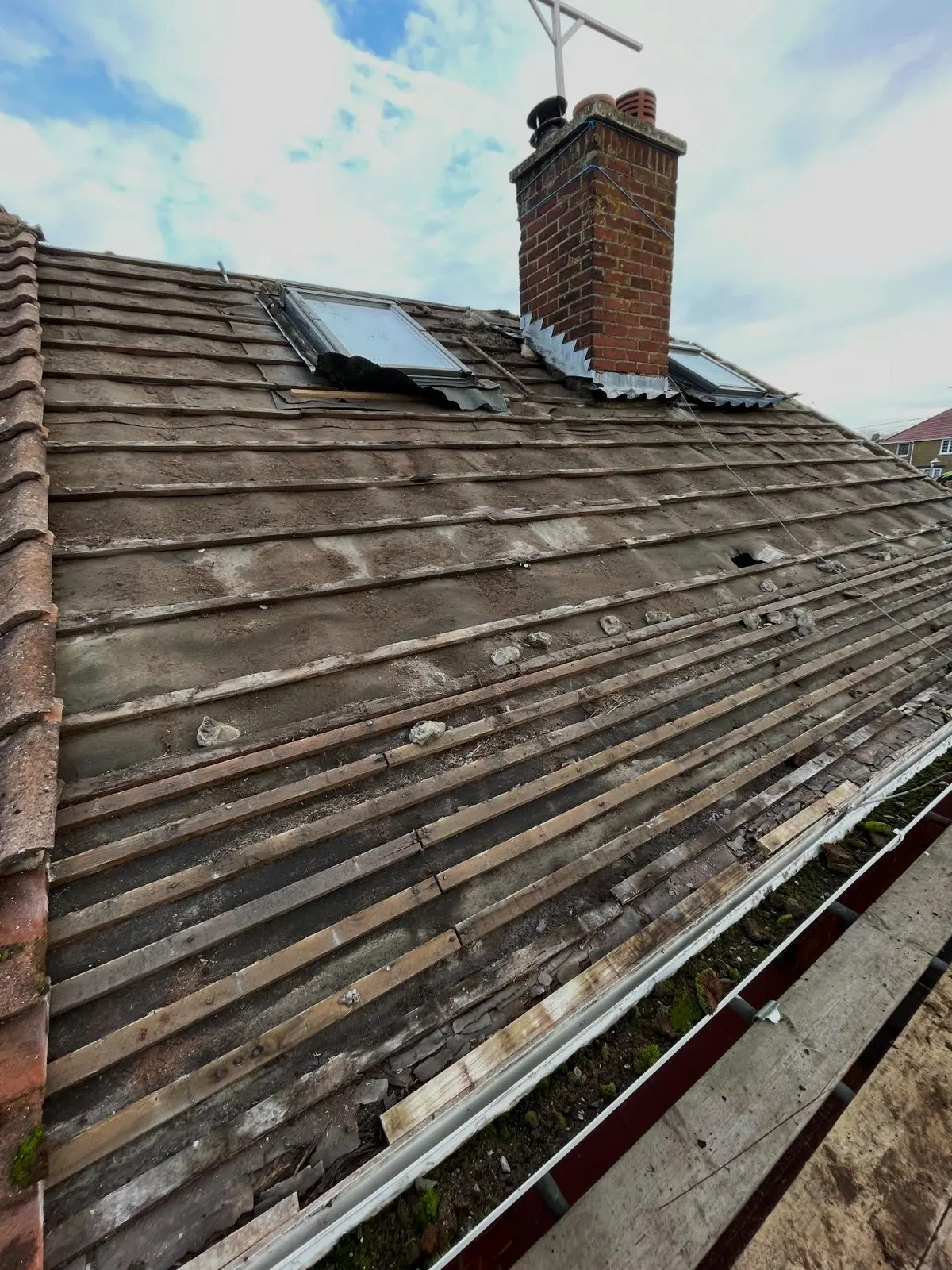
When replacement is the right call, the old covering comes off completely so the timbers can be seen and checked. A new breathable membrane and treated battens go on, followed by your choice of tile or slate. Stripping back is the only stage where hidden damage can be properly dealt with, which is why overlaying or spot-fixing a worn-out roof is rarely good value.
- Full strip of old tiles, battens and felt
- Rafters checked, with timber replaced where needed
- New breathable membrane and treated battens
- Dry ridge and dry verge can be added while the roof is open
How the job works
- 1Inspect inside and outWe look at the roof covering and, where we can get to it, the loft, so the advice covers the timbers and felt as well as the tiles.
- 2Compare the optionsIf a repair will do the job we say so. If a re-roof makes more sense, we explain why and show you photos of what we found.
- 3Choose your materialsFor a new roof we talk through slate, concrete and clay tiles, and what suits the house, then put the price in writing.
- 4Strip, rebuild, photographThe roof is stripped and rebuilt in stages, with photos of the work so you can see what went under the tiles.
Why choose us in Chelmsford
- Quotes for Chelmsford homes are free, with no obligation to go ahead
- You get the price in writing before a single tile is lifted
- Photos of every job, including the parts you can’t see from the ground
Common questions
How long does a concrete tile roof usually last before it needs replacing?
As a rough guide, roofs start to need serious attention at around 40 to 50 years old, though the tiles can outlast the felt and fixings under them. Age alone doesn’t decide it. We look at the condition of the tiles, felt and battens, then tell you honestly how much life is left.
Can I swap concrete tiles for slate or clay when I re-roof?
Often, yes, but it needs thinking through. Different tiles need different batten spacing and pitches, and a heavier covering puts more load on the rafters, which can bring building regulations into play. We’ll check the roof structure and explain what is possible before you decide.
Is it worth replacing the fascias and gutters during a re-roof?
If they are near the end of their life, usually yes. The access is already there, and the bottom row of the roof ties into the fascia and gutter, so doing both together avoids disturbing new work later.
Ready for a free, no-obligation quote?
Speak to our team today. London, Essex, Kent, Sussex and the Cotswolds.